The Gap Between the Office and the Factory Floor
In traditional manufacturing setups, there has always been a significant disconnect—a lag in information—between the top floor (where planning happens in the ERP) and the shop floor (where production actually occurs). Plans are made based on yesterday’s data, printed onto paper travelers, and sent down the line. Days later, completed job tickets are manually entered back into the system.
This delay is costly. Accurate decision-making is nearly impossible when your data is always 24 hours behind reality. How can you promise a realistic delivery date if you don’t know that Machine B went down an hour ago? This is where modern Manufacturing ERP paired with real-time shop floor tracking changes the game.
What is Real-Time Shop Floor Tracking?
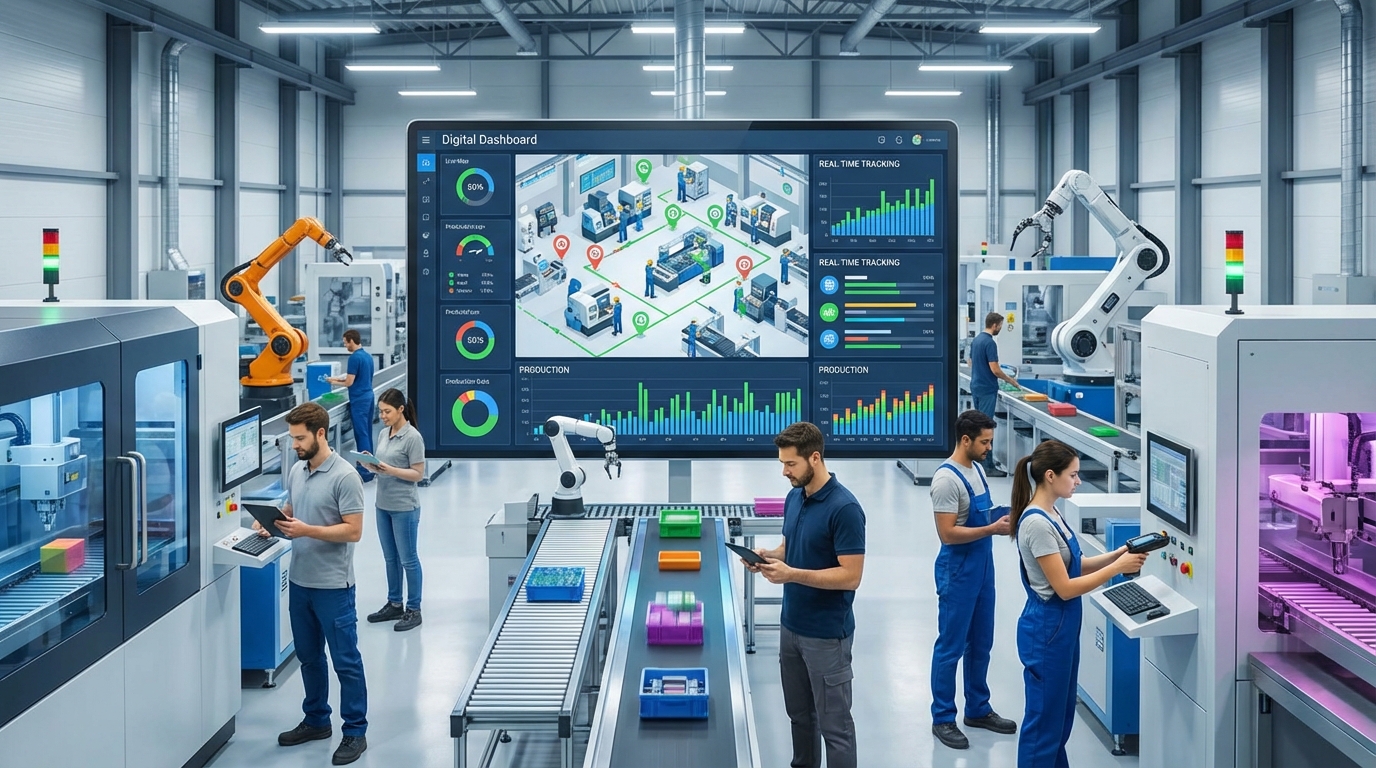
Real-time shop floor tracking (SFT) acts as the digital nervous system connecting your production machinery, operators, and materials directly to your central ERP. Instead of relying on paper and manual data entry at the end of a shift, data is captured instantly as events happen.
This is often achieved through:
- Tablets or touchscreens at work centers for operators to clock onto jobs.
- Barcode or RFID scanners for tracking material movements.
- IoT sensors on machinery that automatically report run speeds, cycles, and downtime to the ERP.
When integrated, the ERP doesn’t just tell the shop floor what to do; the shop floor talks back to the ERP in real-time.
Key Benefits of Closing the Feedback Loop
Integrating real-time SFT with your manufacturing ERP isn’t just about getting rid of paper; it’s about unlocking a level of agility that modern manufacturing demands. Here are the primary advantages:
1. Unprecedented Visibility and Agility
Imagine a production manager looking at an ERP dashboard and seeing the exact status of every job on the floor right now. If a machine goes down, the schedule in the ERP turns red instantly. This allows production planners to immediately pivot, rerouting jobs to other work centers and updating delivery estimates for customers. You stop reacting to yesterday’s problems and start managing today’s reality.
2. Precise Job Costing
Without real-time tracking, job costing is often a best-guess estimate based on standard times. Real-time SFT changes this by tracking:
- Actual Labor Hours: Exactly how long an operator spent on specific operations.
- Actual Material Usage: Precise quantities consumed, including recorded scrap and waste as it happens.
This data feeds directly into the ERP finance modules, showing you the true margin on every single product you ship.
3. Improved Quality Control and Traceability
Real-time tracking allows you to enforce quality checkpoints directly on the shop floor interface. An operator might not be able to clock off an operation until specific quality measurements are entered into the tablet. Furthermore, if a defect is found later, real-time data allows for instant end-to-end traceability, pinpointing exactly which machine, operator, and material lot were involved.
Conclusion
A Manufacturing ERP without real-time shop floor connectivity is like driving a car by looking in the rearview mirror. You only know where you’ve been, not where you are right now. To compete in today’s fast-paced market, manufacturers need the digital thread that connects planning with execution instantly. By investing in real-time shop floor tracking, you turn your ERP from a passive system of record into an active engine of manufacturing efficiency.