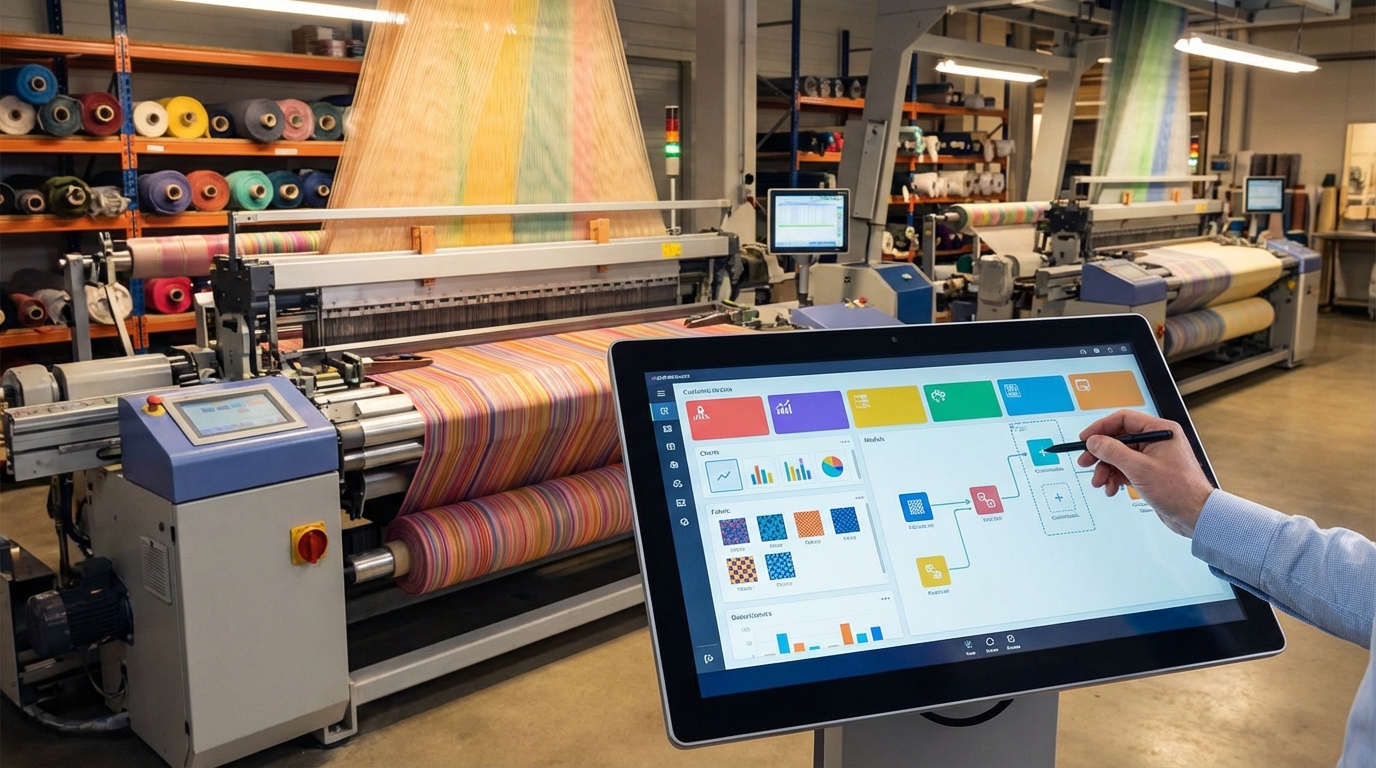
The textile industry is uniquely complex. It operates as an intricate web connecting fiber producers, spinners, weavers, dyers, and garment manufacturers. Unlike assembling discrete parts in automotive manufacturing, textile production involves continuous processes, volatile raw material costs, and an overwhelming number of product variants based on color, pattern, weave, and finish. In such a dynamic environment, managing operations with spreadsheets or disjointed legacy software is a recipe for disaster.
This is where Enterprise Resource Planning (ERP) comes into play. However, for textile manufacturers, a generic, ‘off-the-shelf’ ERP solution often feels like trying to wear a suit that is three sizes too small. The answer lies in customizable ERP systems designed specifically to handle the nuances of fabric and garment production.
Why Generic ERPs Unravel in Textiles
Standard ERP systems are built for widgets—distinct items with simple Bills of Materials (BOM). A textile mill doesn’t produce widgets; it produces fabrics with complex recipes and variant-heavy structures.
A generic system struggles with fundamental textile concepts. It may not understand that 1000 meters of fabric in ‘Navy Blue’ is inventory-wise different from 1000 meters of the exact same fabric in ‘Royal Blue’ due to distinct dye lots. When software cannot accurately track these realities, it leads to:
- Inaccurate inventory valuations.
- Production bottlenecks due to unavailable yarn or dyes.
- High levels of material waste and deadstock.
- Difficulty in calculating accurate product costing.
The Power of Tailored Functionality
A customizable textile ERP adapts to your specific workflow, rather than forcing your mill to adapt to the software. Here are critical areas where customization is non-negotiable:
1. Multi-Dimensional Inventory Management
This is the backbone of any textile operation. A tailored ERP handles inventory not just by SKU, but by a matrix of attributes: yarn count, blend percentage, weave type, color way, finish, and width. It allows for tracking materials by rolls, bales, or batches, ensuring real-time visibility into exactly what you have and where it is.
2. Recipe and Dye Formulation
For dye houses, managing recipes is critical for consistency and cost control. A custom module can integrate with laboratory dispensing systems, store exact dye recipes, manage chemical inventory, and track historical shade matching data to ensure batch-to-batch consistency. Precision here directly impacts profitability through reduced re-dyes.
3. Textile-Specific Production Planning
Planning textile production requires balancing loom availability, knitting machine gauge, dyeing vessel capacity, and finishing line throughput. A customized ERP can generate production schedules that optimize machine utilization based on the specific fabric construction requirements, minimizing changeover times between different weave patterns or colors.
4. Quality Control and Traceability
In textiles, quality issues can originate at the fiber stage but only appear after finishing. A robust system tracks materials from raw fiber to finished garment. If a fabric fails a strength test, the ERP should allow you to trace back to the specific yarn batch and supplier instantly. Integrated quality checkpoints for greige fabric inspection, lab dip approvals, and final inspection are essential features that generic systems lack.
Benefits of a Fitted Solution
Investing in an ERP system that can be customized to the realities of textile manufacturing yields significant returns:
- Accurate Job Costing: By tracking actual consumption of dyes, chemicals, energy, and labor per batch, you get precise costing rather than estimates.
- Reduced Waste: Better visibility into material requirements and optimized cutting plans leads to significantly less fabric waste.
- Improved Compliance: Easily track data needed for environmental compliance regarding chemical usage and water treatment.
- Faster Turnaround: Integrated processes from sales orders to shipping streamline operations, reducing lead times in a fast-fashion world.
Conclusion
In the highly competitive textile sector, operational efficiency is the dividing line between success and stagnation. While generic software might seem like a cost-effective starting point, the operational friction it creates often costs more in the long run. A customizable ERP system isn’t just an IT upgrade; it is a strategic tool that weaves together every aspect of your mill, providing the agility needed to thrive in a demanding market. Don’t settle for off-the-shelf; demand a solution that fits your business perfectly.