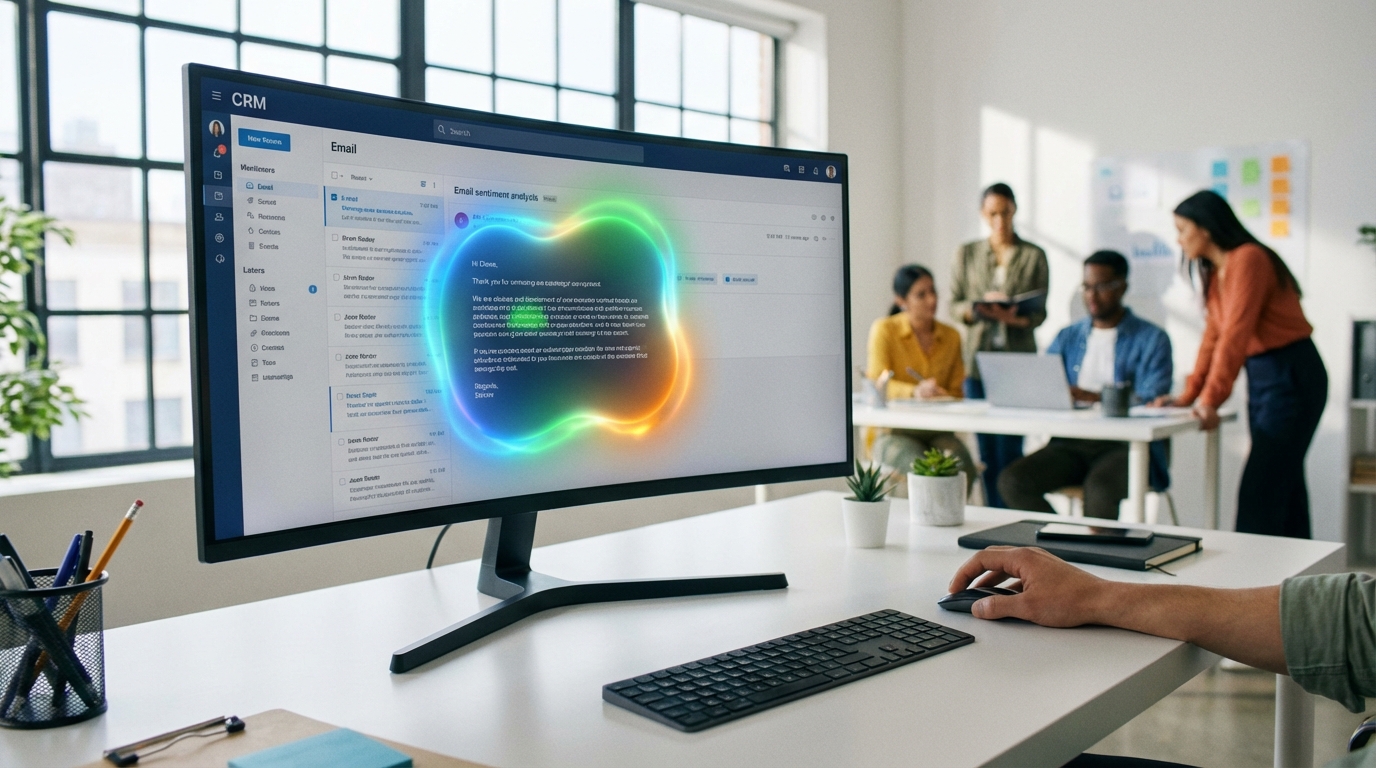
Every day, your business is flooded with emails. Buried within those thousands of lines of text are vital clues about how your customers truly feel about your brand, your products, and your service. But are you truly listening to what they are saying between the lines?
Traditional Customer Relationship Management (CRM) systems are excellent at recording transactions and storing contact details. However, they often fail at capturing the most crucial element of a relationship: emotion. This is where the new generation of CRM software, powered by Artificial Intelligence (AI) email sentiment analysis, is changing the game.
What is AI Email Sentiment Analysis?
At its core, sentiment analysis uses Natural Language Processing (NLP), a branch of AI that helps computers understand, interpret, and manipulate human language. When integrated into a CRM, this technology automatically scans incoming emails and assigns them an emotional score—typically categorized as positive, negative, or neutral.
It goes beyond searching for obvious keywords like “angry” or “happy.” Advanced AI can detect nuance, sarcasm, and the subtle shifts in tone that a busy human agent might miss after reading their hundredth email of the day. It turns unstructured text into actionable data.
Why Your CRM Needs an Emotional IQ
Integrating sentiment analysis isn’t just a neat technical trick; it’s a critical business advantage. Here is how it transforms daily operations:
1. Prioritizing Urgent Cases
Imagine a support queue with 500 unread emails. Without AI, your team likely tackles them chronologically. With sentiment analysis, your CRM can instantly flag an email with a highly negative sentiment score from a key account and route it to a senior manager immediately. You deal with the fires before they burn down the house.
2. Smarter Sales Conversations
Sales reps can view the historical sentiment trend of a prospect before picking up the phone. If recent email exchanges show a trend toward frustration or confusion, the rep knows to approach with empathy and solutions rather than a hard upsell. Conversely, a sudden spike in positive sentiment might indicate the perfect moment to close a deal.
3. Proactively Reducing Churn
Customers rarely quit overnight. There is usually a slow build-up of dissatisfaction. AI tracks sentiment over time, allowing you to spot a declining trend in a customer’s tone weeks before they threaten to cancel. This allows your success team to intervene proactively.
Real-World Scenarios
How does this look in practice? Here are a few examples of sentiment analysis at work within a CRM:
- The Crisis Aversion: An email arrives stating, “I’m very disappointed with the recent update; it broke our workflow.” The AI tags this as highly negative. The CRM automatically creates a high-priority support ticket and alerts the account manager via Slack.
- The Warm Lead: A prospect replies to a newsletter, saying, “This new feature looks intriguing, exactly what we’ve been discussing internally.” The AI tags this as highly positive. The CRM tasks the assigned sales rep to call within the hour.
- The Product Feedback Loop: Your product team can analyze aggregate sentiment data related to specific feature keywords, quickly identifying what users love and what is causing frustration.
Conclusion
In an increasingly digital world, empathy doesn’t scale easily—but AI is helping bridge that gap. By upgrading to a CRM equipped with AI email sentiment analysis, you aren’t just organizing data; you are equipping your team with the emotional intelligence needed to build stronger, longer-lasting customer relationships. It’s time to move beyond just managing customers and start truly understanding them.