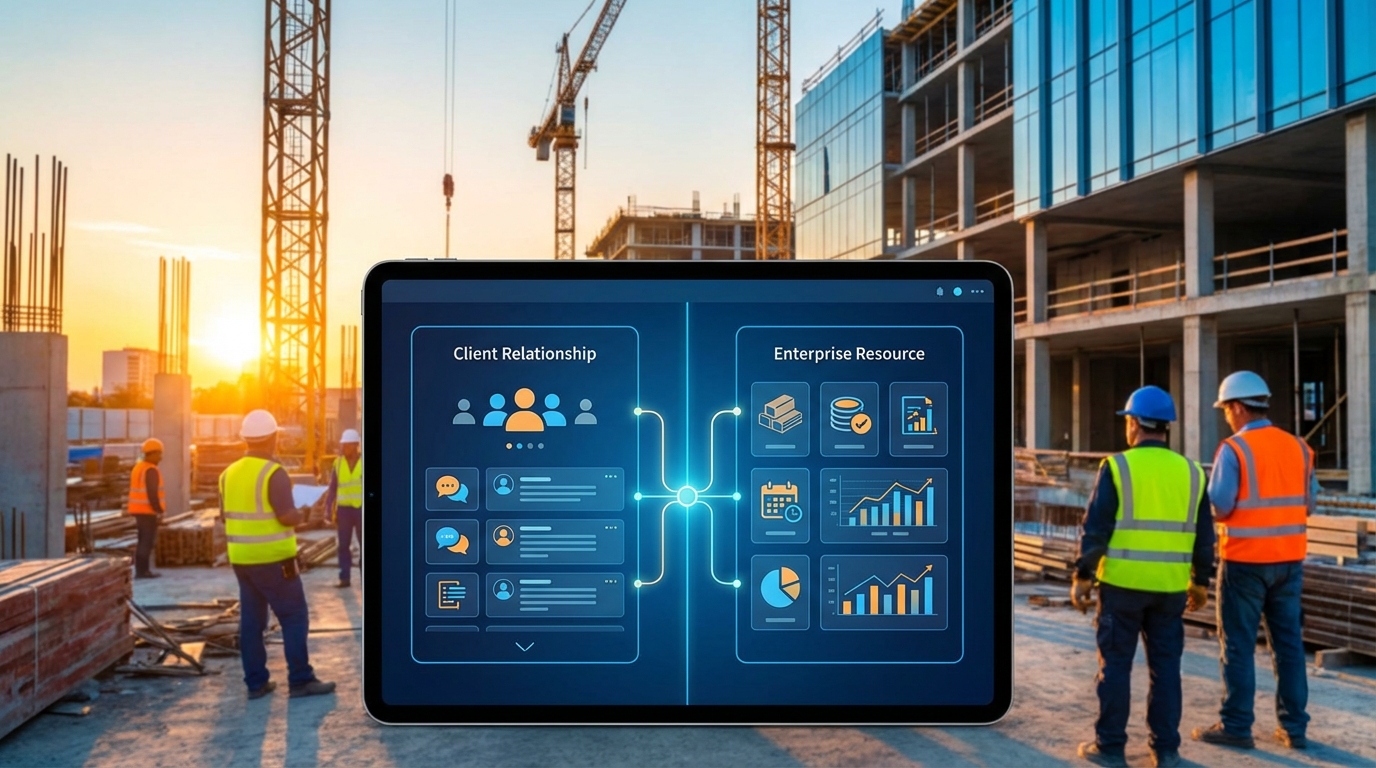
The construction industry is notoriously complex. You have teams chasing new business in the field, estimators crunching numbers back at the office, and project managers trying to keep active sites on schedule and under budget. Often, these departments operate on entirely different systems, creating a chaotic environment where vital information falls through the cracks.
Historically, sales and business development teams use Customer Relationship Management (CRM) tools to manage leads, track relationships, and win bids. Meanwhile, operations and finance rely on Enterprise Resource Planning (ERP) systems for job costing, payroll, procurement, and accounting. The problem? In many construction firms, these two vital systems rarely speak to each other. The result is data silos, duplicated effort, and costly miscommunication. It’s time to bridge that gap.
The High Cost of Disconnected Systems
Imagine this common scenario: Your sales team wins a major bid. They celebrate, mark it as “closed-won” in their CRM, and move to the next prospect. Meanwhile, the operations team is in the dark. They have to manually re-enter data from estimators’ spreadsheets into the ERP to set up the project.
This manual handoff is exactly where errors creep in. Critical details about scope inclusions, specific timelines, or client quirks get lost in translation between sales promises and operational reality. Disconnected systems create a massive barrier between promise and execution. Furthermore, without integration, finance teams struggle to get accurate, real-time views of project profitability because estimates live in one system and actual costs live in another.
How Integrated CRM and ERP Works
An integrated solution connects the entire project lifecycle, from the very first lead to the final invoice. It transforms linear, disjointed processes into a continuous loop of accurate information.
From Seamless Bid to Efficient Build
When CRM and ERP are integrated, the moment a bid is marked as “won” in the CRM, the data automatically flows into the ERP. The project is instantly created, initial budgets are established based on the approved estimate, and resources can be tentatively allocated. There is no double entry, no lag time, and significantly reduced risk of data entry errors.
Top Benefits for Construction Companies
Moving to an integrated tech stack isn’t just about IT convenience; it’s a strategic business advantage that directly impacts the bottom line.
- Real-Time Job Costing: By connecting pre-construction estimates directly to actual project costs as they accrue, you get real-time visibility into profitability. You know exactly where you stand on every job, every day, allowing for course correction before it’s too late.
- Frictionless Project Handoffs: The transition from sales to operations becomes seamless. Project managers inherit all the context, documentation, and client communication history from the sales phase, allowing them to hit the ground running.
- Better Forecasting and Resource Management: With a clear view of the sales pipeline upcoming in the CRM, combined with current resource utilization data in the ERP, leadership can make smarter decisions about hiring, equipment acquisition, and future bidding strategies.
- Single Source of Truth: Everyone, from the CFO down to the site supervisor, is looking at the same data. This eliminates internal disputes over whose spreadsheet is “up to date.”
Conclusion: Building on a Stronger Foundation
In the low-margin, high-risk world of construction, efficiency is everything. Relying on disjointed legacy systems is a shaky foundation for growth in a digital age. By integrating your CRM and ERP, you aren’t just buying software; you are investing in operational clarity, reduced risk, and long-term profitability. Don’t let data silos hold your business back; connect your teams and build smarter.